Showing posts with label Rhea Victor Edwin. Show all posts

Wednesday, February 19, 2014

Day 19 - Victor Edwin Rhea

Victor Edwin Rhea is easier to write about. My cousin, Patty, and I had to good fortune to meet Sheldon Livesay and his wife, Linda, last year when we made a trip to Tennessee to find our “roots”. Sheldon manages “Of One Accord Ministry”, an outreach that feeds and ministers to those in need. It’s a great program and we were blessed to have the chance to see it in action. Sheldon is our 2nd cousin and Victor’s grandson.

Sheldon and Linda

Not only did Sheldon share the work he does, he took the time to show us where the family lived and all the places they would have been. It was a great experience. We were disappointed to find the Home Place gone but the foundation was still there. He showed us Victor’s home but the forest is reclaiming it too. We saw the river and the land they farmed. Sheldon also unearthed a treasure trove of photo's that Victor's daughter Jewelle had saved. It was a fantastic find and added so much to the research. 


Victor was the 7th child of John and Jane. He was born July 13, 1880. 

Victor was the son closest to Jane. Her letters to my grandparents were all about what Victor was doing. My grandmother wrote to him and told him after Jane died, that anything she had should go to him as "he has been faithful to his mother". 

Victor married Cornie Hutson when he was 35-years-old in 1915. She was 24. They had three daughters. I think it was to offset the seven boys Floyd had. 

Jewelle Leona Rhea was born in 1917 and passed away in 2002. Opal Olive Rhea was born in 1920 and died in 2002. Mossie Rhea, Sheldon's mother, came along 5 years later in 1925 and died in 1992. 

Cornie, Victor, Mossie, Opal, and Jewelle

Victor and Cornie's home

Victor's farm was not far from his childhood home. He and Cornie lived there until they were much older and then moved to Rogersville to live with Jewelle. 

Victor passed away in April 1973 and Cornie joined him in July of the same year. He outlived all his siblings and was 92 when he died. 

Cornie and Victor Rhea


Monday, February 17, 2014

Day 17 - Washington Floyd Rhea


One way to carry on the family name is to have seven boys. Washington Floyd Rhea and Eliza Manerva Seals did just that. It is a pleasure to report that the youngest son, Robert is still living and despite Alzheimer's, is still at home with his wife. June takes good care of him and their two daughter help as well. June shares bits and pieces of what she remembers of the past. It is always a treat to hear from her.

Washington Floyd Rhea, called Floyd, was born on January 2, 1873 in Sneedville, Tennessee. Jane and John already had Andrew, Laura and Leona when Floyd came along. Two more sisters came after him. Della and Luvena were just babies and not much fun to play with.

Floyd was seven when Andrew died and he missed him a lot. He was at that age when sisters were just icky girls. He followed Andrew around and tried to do everything he did. Victor was born just months before Andrew died and Floyd vowed he would be the best big brother ever.

The Rhea boys grew up without their father. I know they were close to their mother and as adults, worked to make her life better. Even my grandfather, who moved far away, lived at the Home Place until he married. Floyd and Victor never left Sneedville and were very much a part of Jane’s life.

Floyd was 30 when he married 17 year old, Eliza Manerva Seals. The Seals were also a large family living in Sneedville and there were lots of Rhea/Seals marriages.

In later years, Jane would write that Floyd had made molasses or had a fine crop of tobacco. She would share that Eliza was waiting for a letter from my grandparents.

Floyd died on February 3, 1929 at the age of 56. Although there is a death certificate, the cause of death is illegible. It must have been a hard year for everyone because Jane died a month later on March 22, 1929. In a letter my grandfather wrote to Victor, he mentions Jane’s passing but nothing was said about Floyd. We don’t have any other letters between the brothers. Eliza lived a long life, passing away on November 11, 1961 at the age of 75. 


Photo taken the same time as the top picture, this is Floyd's family. On the left is his mother, Jane. The oldest child is Robert and he is in both pictures. Floyd is holding Guy and Eliza is holding Homer. The picture is one that Sheldon Livesay, my second cousin,  found and shared with me.


Photo was taken in the mid 1980's when my parents went to Tennessee for the first time to meet the family. My dad is on the left, Hugh, and Howard, two of Floyd's children are on the right. This is the Home Place.  

Saturday, February 15, 2014

Day 15 - Laura Isabelle Rhea

Laura Isabelle Rhea was born on February 15, 1870. She was the second girl, two years younger than Leona. She had been a baby when the family moved to the Home Place.

She was five when Luvenia was born and seven when Della was came along. She had visited the Cliff House with Andrew hundreds of times and was glad they didn’t live there anymore. It was way too small and the bedroom at the Home Place was big enough for all the girls. By the time Lillie was born she was already 14 years old and had more concerns than just another baby moving into the bedroom.

Her daddy had been murdered and there were times when she thought she couldn’t stand it anymore. Fortunately, there were many tasks to do daily that helped her keep her thoughts at bay.

There were also cousins who came to visit. Carolyn’s kids were younger; Ida was 5 years behind her and a pain in the backside. She liked it when they came from Virginia to visit but Ida was closer to her brother Victor. It seemed the two of them were on a campaign to drive not only her and Leona crazy but their parents as well.

Caroline and Robert made the trip to Sneedville in the summer of 1890. Laura was 20-years-old by the time and had conned Leona into helping her make fruit pies for the guests. The apple tree next to the house had produced an abundance of apples and they needed to use them up.

Leona explained to her husband how Laura needed to learn some basic baking skills and needed her help. Columbus only smiled and said he would spend the day with their year-old-daughter, Bobbie, while she went off to bake pies.

Laura and Leona spent the entire morning working together to make enough pies to serve at the big family dinner planned. The fact that Caroline and Robert brought all eight of their children added to the overabundance of family already gathering at The Home Place. 

The kitchen smelled delicious and although it seem cliched, they set the pies on the window sill to cool. They were proud of their handiwork and were looking forward to the compliments they knew they’d receive.
What they didn’t count on was Victor and Ida. When they were smaller, they took delight into dumping the older girls into the river from the boat. The older girls had learned never to get in a boat with them.

Leona took off to check on Bobbie and Columbus. Laura made the trek to Polly’s house. It was her job to make sure her grandmother got to dinner safely. Neither gave any thought to the pies left out to cool.
Victor and Ida had been watching. They were hoping to get a piece of pie but the girls had shooed them away. The stalked away, taking up a hiding place to watch. If they had a chance, they were going to get some pie when no one was looking.

The opportunity arrived when they watch them leave the house. The kitchen was empty and the pies were on the window sill. They crawled to the window and snatched a pie. Sitting with their backs to the side of the house, they took a slice each. It was so good and before they knew it, the pie was history. In fact, it was so yummy, they decided another taste was in order and grabbed one more. They polished that off in no time flat and were reaching for the third when they heard voices. Scrambling through the bushes that lined the house, they disappeared from view.

It was Jane who noticed that there were only six pies on the window sill. Surely Laura and Leona had made enough for the whole family. She set off to find one of them. Six pies were cutting it close. As she came around the side of the house, she noticed two empty pie tins on the ground below the kitchen window and knew immediately who had taken the pies.

When Laura came back with Polly, Jane pulled her aside to tell her about the pie theft.  Laura was mad. Ida and Victor had crossed the line. It was too late to make more so Jane decided that when it came time for dessert, the two of them wouldn't get any. They needed have worried; Victor and Ida didn’t eat dinner. After consuming both pies, neither of them was hungry.

As they got older, Laura and Ida became good friends. In letters Ida wrote letters to family, she shared several things she and Victor did as kids usually at the expense of Laura and Leona.

Laura looked back on those times with fondness. Two years after the pie fiasco, Laura married Hamilton Green. He was 10 years her senior and had grown up in Sneedville too. His farm was not far from theirs and he was a family friend. They first eight children were born in Sneedville and the ninth when they moved to Narcissa, Oklahoma in 1910.


Hamilton died at age 60 in 1920, ten years after they moved. Laura lived to age 95. 

Wednesday, February 27, 2013

Continuity - Day 27 of the Family History Writing Challenge

Throughout Martha Jane's life, there were wars. Although she didn't live to see World War II, she certainly saw the devastating effects of the Civil War and World War I. In 1918, when she wrote the letters, World War I was just ending.

She writes on January 1, 1918:

“Leona’s and Della’s boys all right since the armistice was signed. Don’t know when they will be at home, Perhaps not soon. Roy Hatfield says he is homesick.”

Roy Hatfield was her grandson, the son of her daughter Della. In the picture: Victor Rhea, Martha’s son, her grandson Roy (son of Della), her granddaughter Mossie (daughter of Victor), and a neighbor child.  
Roy registered for the draft on June 5, 1917 and served from September 20, 1917 to April 12, 1919. He was 22 years old when he registered. The registration form says he was tall and stout with blue eyes and yellow hair.


I don’t think that Roy had been discharged when the photo was taken but his homecoming would not be as hoped. During the war, he had been part of the group that had been attacked with Mustard Gas. I don’t pretend to know anything about it other than, many times, it was fatal. That was not so with Roy. He survived the attack but soon after returning home, he was sent to the US National Home for Disabled Volunteer Soldiers. The diagnosis there was arthritis.  

We know that he was back in Sneedville in October 1919 because Martha writes:

“Roy and Sam still running trucks.”

Sam was Roy’s younger brother and both of them worked for the mining company. I haven’t spent much time with Della’s family other than to document the notes my mom made when she went to Sneedville, Tennessee in 1982. There are many missing details but what struck me about the family was the amount of tragedy is a small space of time.

My friend started Ancestry.com yesterday and found some information right off the bat that her mom has been lying to her for years. I told her that she would find things that might be upsetting. Today, the Hatfield’s upsets me.

Roy Hatfield died in 1938 at the age of 43 by committing suicide. One has to imagine that the war had something to do with his state of mind and health.

How sad for the family so I thought I’d look at the rest of the kids.

Jessie Hatfield is hard to find. We have a birth year for her but no death date.

George Dewey Hatfield is the next in line. He had moved from Tennessee to Indiana and died at the age of 69.

Sidney Hatfield is next. We only have the year of his birth but no other information is available. However, the notes we have say that he committed suicide.

John Hatfield lived to age 82 in Indiana.

The next sister was Carrie Hatfield. There is not much information for her either.

Next comes Sam Hatfield who Martha mentions in her letters. We have no death date for him either. Again, there are more notes that say he had cancer and committed suicide.

Edna Hatfield lived to the age of 92. According to the note left on Find A Grave, her granddaughter posts a glowing report of how wonderful her grandmother was.

Grant Hatfield also moved to Indiana and lived to be 72.

Ray Hatfield, age unknown died of lung cancer.

Luke Hatfield had also captured my attention because Martha said he “Favored Wm a great deal.” William was my grandfather. Unfortunately, Luke died in 1937 at the age of 18 in a car accident.

We have Roy, Sidney, and Sam who committed suicide. Ray died of lung cancer and Luke died in a car accident.

Della Hatfield was her mother’s child. She was also a strong woman who had the ability to rise above whatever life threw at her. However, the saddest part of all is when Mack Henry Hatfield was 81, he also  committed suicide. We don't know why but maybe he just couldn't deal with the death of his 5 sons. It is one of the things I want to find out when I make the trip to Tennessee. So much heartbreak but Della hung on for another 15 years and died at the age of 83.

Tuesday, February 26, 2013

Faith – Day 26 of the Family History Writing Challenge


We are in 6th grade this year and studying ancient history and the beginnings of the world’s religions. Ok, our grandchild is in the 6th grade and studying history. However, after learning it myself more than 50 years ago and then learning with my boys, we are now doing it all over again with our grandchild.

I am much older and wiser and know a bit more about Confucianism, Buddhism, and Hinduism. Our 6th grader is at the age to question belief systems and how they relate to him. He wants to know if it is wrong to learn about the other beliefs. I tell him no. I questioned my basic Baptist beliefs. My preacher grandfather told my mother it was all right to question hers. It’s a normal right of passage.

He asked recently why my beliefs are Christian and not one of the others. My response; underneath all the dogma, all belief systems are similar. He is free to choose which one fits in his life. Christian belief is a choice and must be made freely. He has asked for the “bible” for each one and I will grant his wish.

What does this have to do with family history?

When I found my grandmother’s letters, I was instantly struck by the passage she wrote on January 1, 1919.

“Wm, I am 71 years old this morning and I want to talk to my absent children. What I can and truly hope that when the end of their road is as near is Sight as mine they can Rejoice as I can, that Rest is near.”

Martha Jane was tired. She wanted William to come home but beyond that, there was no fear of death. She had already made peace with her maker. I find that comforting and based on my belief system, know that when I get to Heaven, she will be there to greet me. However, rest was not as near as she thought because she lived another 10 years.  

When she passed away, my grandfather wrote on May 30, 1929:  

“It was very depressing news of Mother being dead. Yet we all must answer the Summons when it comes.” Grandpa also believed.

Family history is more than dates and times. It is an affirmation of who we are and where we came from. My beliefs tie me to my great grandmother, her sons, my parents, my children, and grandchild. What matters to me is that my beliefs were shared with my earlier ancestors. Many of the Rhea’s were preachers. Many of my mother’s family were preachers. Yet, all of us questioned our beliefs.  

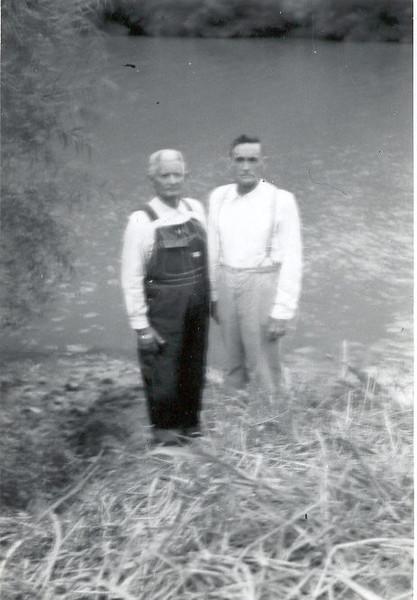
This was graphically illustrated when my 2nd cousin sent me the pictures he found. There are picture of my grandfather’s brother, Victor, being baptized in the Clinch River.


He was not a young man. I don’t know why he was baptized so late in life but that’s irrelevant. What counts it that he walked in the same path that I have chosen. While we spend time living our lives, the thread of belief runs deeper than any of us realize. Understanding that allows me to encourage my grandchild to look at the all the belief systems. Whatever he chooses will be right for him, even if he is as old as Victor when he makes his decision. He will know that those who have gone before him will welcome him with opened arms.  

Monday, February 25, 2013

Pictures – Day 24 of the Family History Writing Challenge


Sheldon Livesay, who runs Of One Accord, an outreach ministry and food bank in Rogersville, Sneedville, and Church Hill, Tennessee, is my 2nd cousin. He is a busy man who has joined me on my journey and found, like I said in an earlier post, documents and pictures. He has been scanning photos into his website.

The photos are a treat. People who were just names have faces. They lived in homes and played on the river. There is a picture of my grandfather’s brother, Victor, being baptized in the river. They photos offer comfort.

My grandfather left Tennessee and moved to Montana, far away from the family. Cut off from the Tennessee family, us kids grew up without knowing much about them. We were an insular family with just the three brothers. My uncle Ralph, stayed in Montana, married Bernice, but had no children. My uncle Howard, move to the San Francisco area and had five kids. My parents moved to Southern California with just my brother and I.

I have been playing with genealogy for a long time and I can recite names and dates from memory. Now, for the first time ever, these have become real people. Today on day 24, I am posting some of these remarkable images.

Let’s start with Sheldon. I cannot say how grateful I am for his help.


Sheldon in the grandson of Victor Edwin Rhea, brother to my grandfather William Ogden Rhea. Victor married Cornie Hutson.


Victor and Cornie had three daughters. The oldest is Jewelle. In the letters my great grandmother wrote to my grandparents, she mentioned that Jewelle sucked her thumb. Before ever seeing a picture of her, she had already become a real person. Tidbits like that make the research fun. Opal is the next sister and Mossie (Sheldon’s mother) is the youngest.


We don’t have many pictures yet of Washington Floyd Rhea, another of grandpa’s brothers. I am also in search of pictures of Martha Jane. I have two in my possession but Sheldon posted another.

This is Floyd Rhea, his wife Elisa and three of their seven boys, John, Guy, and Homer. Martha Jane Rhea is on the left. Floyd’s youngest son, Robert is 90 and still living. His wife June and I have begun writing to each other. She says they have been married for 71 years.  


This is so exciting. What is even better is I am not alone anymore. I have help from my cousin Patty and Sheldon. Even June is willing to help although Robert has dementia and doesn’t remember much, she has shared a little of her life and childhood. I appreciate her so much.


Wednesday, February 20, 2013

My grandpa has a voice – Day 20 of the Family History Writing Challenge

We have been blessed this week with a second cousin in Tennessee who found a treasure trove of documents. A big thank you goes to Sheldon Livesay for his time and willingness to join in our search. I now have copies of deeds for property bought and sold in the 1800’s. This is interesting because although I don’t have any clue about plot lines and boundaries, I can find out. For instance, Sheldon found the deed where John Carter Rhea bought 75 acres on April 19, 1883.

However, the most exciting find was the letter my grandparents wrote to Victor Rhea on May 30, 1929. What tugged at my heart was the reference to Martha’s death on March 22, 1929.

My grandparents (as far as I know) never went back to Missouri or Tennessee. They were unhappy places for her. We wondered if my grandfather had even been back to see his mother. He left in 1914 so it would have been 14 years. We still don’t know the answer. What we do know is Grandpa traveled without my grandmother. When we were children, we used to visit him in Mesa, Arizona while Granny stayed home to tend to business. Grandpa had tuberculosis and the desert air was better for him than the long cold Montana winters.

In discussing my grandfather with my cousin Patty, we discovered we don’t know much about him. She has a few memories and I have some but it doesn’t tell us who he was. He was a very quiet man, not given to long speeches or idle chat. He was very tall and very trim, hence his nickname “Slim”. My grandmother was the driving force. She was an astute businesswoman and had several business interests.

The letter is the first we’ve seen in his handwriting. My grandmother wrote all the letters to my parents. This is the first time that Patty and I have heard from him in his own words.

He starts his portion of the letter talking about the farm. While we visited them in the house they built in 1932, in 1929, they were still living on the farm away from downtown Billings. Grandpa was employed full time by the railroad so the workload he carried would be staggering today.

He had just planted 600 pounds of potatoes, over an acre with Bantam Sweet Corn, and still had an acre to plant with miscellaneous vegetables like carrots and onions. He talks about taking care of the chickens. Then he writes,

“It was very depressing news of Mother being dead. Yet, we all must answer the Summons when it comes.”
We were shocked that of all the letters that must have been written, this is the one that survived. It answers some questions and provides very real emotions, which can’t be gleaned from the drier facts.

William goes on to ask,

“What did they do with Dow Arnold for killing James Willis?”

I have no idea what that’s about but because my grandfather wanted to know, so do I. It will not make any difference in my family history but it just adds flavor and texture to the story.

My grandmother wrote the second half of the letter. Her handwriting is instantly recognizable. She starts with the pleasantries and then says,

“It made us sad to hear of Mother’s death and what hurt most was that Wm had neglected to go to see her. I often urged him to go but he always said it hurt his mother so to have him leave her again. He would have gone if he had knew she would lived as long after Leona wrote him but it is always like that. Something to regret.”
Apparently, they, (Victor and Cornie) offered her the robe she had sent. She writes,

“No I don’t want the bathrobe. You do what you want to with it. I think Victor is entitled to the corn and what ever else they give him. He has been faithful to his mother.”

She then goes on to talk about the chickens she is raising and working in the garden. That is something else to research. If they were planting acres, what was in the garden?

The best thing about the letter is that for the first time, we know the emotions behind the facts. Grandpa was sad. Grandpa had regrets. Grandpa believed that everyone’s time on this earth was limited and accepted the death as a larger part of the universe. It was nice to hear from Grandpa. It was nice to hear Grandpa’s voice.


Tuesday, February 19, 2013

Money – Day 19 of the Family History Writing Challenge

My great grandmother was money savvy. Martha had lots of money tips for her son, William, and his wife, Mellie. I covered those on Day 16.

In her letters, she also shares details about the people around her and their transactions. I took these snippets from her letters dated November 22, 1918 and January 1, 1919.

“King Hutson paid 3900 for that piece of land after Ans Mathis had bought a strip next to him for 500 dollars, making that piece cost 4400. King Hutson let Samps Henry and Levi Hutson have it. John Jaynes paid 3000 for that strip between then and George Baker.”

King Hutson was Cornie’s father. She married Martha’s son Victor. I don’t know what “Samps” is but Henry and Levi are Cornie’s brother. Cornie had a sister named Cora who married so she would not have inherited the property either. This bit of information sent me on a lengthy search for Cornie’s parents. I had read King Hutson in the letters and knew Cornie’s last name was Hutson and I thought they might be related. However, my information on Ancestry.com did not support that. I started over again today and found that King was indeed Cornie’s father. I also found that all the sisters and brothers I had for him were wrong and had to be deleted. He does have three siblings. Alice and Amanda were spinsters and lived with his family until they died. What I found even more interesting is he is the third child and his name is King Samuel. That’s from the Bible. Although his older sisters have what I think are normal names, his is different, and his younger sister is Queen Elizabeth Hutson.

Martha’s next portion of the letter talks about her holdings and crops.

"Wm you can hardly imagine what this farm will be worth in 4 years from now. The timber and ore. By that time the timber will be scarce and ours will be a price. You can mine your own ore have it crushed or sell it Raise poultry and vegetables. They are leasing to other companies so I am told.

The Suckers where we raised tobacco is green and blooming. I have enough green mustard in the garden for 20 families. lots of garden huckleberries.

Wm, there is scarcely any more logs run, The people saw crossties a run them but not half what they did 2 year ago. Timber nearly all used up. We all have the most timber I know of. Frank Rhea is sawing for the co for 3.50 per day.”

The co (or the mining company) fills a portion of the letters.

“The co has made Henry Hatfield’s land worth something. Henry wont sell. The CO have paid all the second payments. They claim the mineral is fine.

Wm. Times is dull here now, not much doing. The mining people is going slow. wages for common work is 1.50, carpenter 3 or 3.50. They have built 15 swelling houses and is building a large building for the machinery and a large store house. A man by the name of Coberly from Joplin, M.O. is here to setup their machinery. His family is here. They claim to have one million and quarter dollars worth of mineral in sight.”

She writes about the Hatfield’s. They were not only neighbors; her daughter Della married Mack Hatfield, the son of Henry. Mining was the biggest thing in town and one of the reasons my grandmother did not want to live there.

Martha worked hard for her survival but she did well.

Saturday, February 16, 2013

Bribery – Day 16 of the Family History Writing Challenge

In 1918, Martha writes that she wants to talk to her absent children. She doesn’t specify which ones so we are left to guess. Andrew died somewhere after his 14th birthday. Luvena died at age 37, five years before the letters were written. Laura was married and lived in Oklahoma. William (my grandfather) had married and in 1918, lived in Montana. Mary lived in the next county over. That left, Victor, Floyd, Lillie, and Della at home.

On November 22, 1918, she wrote to William:
“But I was expecting you to come. It is a heavy disappointment to me.”
She really wanted him to come back home. She is very aware of what is happening in the country. They didn’t have electricity so no radio but news was shared throughout the area.

Grandpa worked for the railroad and didn’t make a lot of money but Grandma was thrifty and could certainly make the money last. Still, Martha was concerned.
“I wanted you to come and try to farm or something that wouldn’t leave you on Starvation if you get sick. It troubles me more than I can tell you. To think if you get sick or hurt you would have nothing to ward off starvation. You never can save anything on Public Works. The next 3 years will be hard to live. Prices will be so high, and nothing growing to you will make hard times for you. If you can come I will rent the ground from the house down. Let me know soon. Wm, if you could see as I do you surely wouldn’t depend on Public works for a living.”
One of the things I remember my grandmother saying is that she didn’t want Grandpa to work in the mines. She was adamant about the mines and part of the reason they moved. Grandma would not have been pleased with the next part of the letter.
“Wm, I think this mineing Co will start things lively now the war is ended. They have brought in a boiler that has taken 2 month to bring it from the Mntn. They are mining and building. Some workhands are scarce. Della's Sam has been running their big motor trucks bringing supplies from the mountain.”
Changing tactics, Martha goes back to being self-sufficient.
“Wm, if you had a few acres of the Burk place or there close before the boom comes. Be we have here good enough if we could improve it and (unknown) it shape, we are just the proper distance. For all but school, I would like for you to tell me just what your think of it. I’ve yet have 5 good hogs to butcher I’ve thought you would come and killed a shoat weighing 160 lbs. Pork has been selling for 25 cts. I think corn will be 2 dollars.”

January 1, 1919 Letter to William:
While Martha shares family information, she is still trying to get them to move back.
“It is raining now. When it clears up Victor wants to kill 3 large hogs. I wish you and Nellie and Ralph was here to help. Wm, can you use home made tobacco. tell me I will send you some. Did you get the check for rents in my last letter.

Write me all you plans for the future Wm., couldn’t you buy cheaper from people in the country and save something.

Nellie could you raise a pig or can you have chicks. I would want one or the other. A pig would grow dollars fast. Come out here I will give you one. Is Wm working of a Knight yet. I wish he had a daylight job. Nellie write me often if nothing but a postcard. Tell Ralph I want him to come here and play with Jewel so I can write. She tries to help so much I cant hardly do anything for her. All of you come to see me.”

October 10, 1919

In the 1910’s the railroads were looking for reforms. In 1916, they secured the Adamson Act that provided 10 hours of pay for an eight hour day. They carried out a national strike in 1919 but the strike was not successful in making further changes. Martha is worried about Will’s safety and offers some advice and the invitation (again) to move back home.
“Wm, Tell me all about the strike will they bring you in it. If so, take no hand in the Rioting. Be just as quiet as you can. Spend some of your time writing to me or come and stay with me.”

We only have the five letters written by Martha to William. They cover only one year in the lives of these people.

My grandmother would never have gone back to Tennessee or Missouri where she was from. As I wrote in an earlier post, once my grandma made up her mind, it was all over. I can not say for sure if they ever went to Tennessee for a visit but if I were to hazard a guess, the answer would be no,

The letters make me sad. Martha tried her best to entice them back to Sneedville. I must have been hard for her. The girls all married young and although two of them stayed in town, they had their own lives to live. The boys all married when they were in their late 20’s or early 30’s. She got used to having them around. She wanted my uncle to grow up with the rest of the grandkids and would have enjoyed William's other two boys. However, it was just not meant to be.

Friday, February 15, 2013

World War I - Day 15 of the Family History Writing Challenge

Martha’s letters were written in 1918 and 1919. The war had been going for a while but the Selective Draft Act was not enacted until May 18, 1917. The Selective Draft Act was canceled in November 1918 at the end of the war.

Fortunately, for the family in Sneedville, there were no lives lost. Victor, Floyd, and William all registered for the third registration held on September 12, 1918. The first two drafts were for younger men up to the age of 31. The law was amended and the third draft allowed men up to the age of 45. While all of Martha’s boys registered, none were called to serve.

We have draft records for all three. The registrar in Sneedville was more diligent in his completion of the forms. In Montana, they were not quite as meticulous.

Victor registered at the age of 38 on September 12, 1918. He listed his address as Sneedville, Tennessee. It says he was married to Cornie and his occupation as a farmer. He was of medium height and weight with blue eyes and brown hair.

Floyd registered at the age of 45 on September 12, 1918. He listed his address as Sneedville, Tennessee. It says he was married to Elisa and his occupation as a farmer. He was also of medium build and height with blue eyes and brown hair.

William registered at the age of 36 on September 12, 1918. He listed his address as 104 So. 28th in Billings, Montana. I know he and my grandma lived at 124 No. 24th Street when I was a child so in 1918, they had not built the house yet. He was married to Mellie. He was of slim build and tall but no eye or hair colors were listed. His occupation was a mailman for the railroad. That’s another story too about how he was the one who hung the mailbags of the post for the trains to snag as they came by.

Martha writes on November 22, 1918:

“Surely you are rejoycing over the awful slaughter ending. Did you get questionnaire, Victor didn’t.”

(The World War I questionnaire project (Record Group 239) was part of an effort to gather and preserve the history of Tennessee's involvement in what was then known as the Great War. http://tennessee.gov/tsla/history/military/ww1quest.htm)

She writes again on November 25, 1918:

“Nellie, I am so glad Peace is made. Surely every person in the world is thankful. I suppose Roy Hatfield and Leona's boys are living, was the last I heard.”

As an aside, my grandmother’s name was Mellie. I don’t know if she purposely writes her name incorrectly or not. I am of the opinion that they would not have gotten along living in the same place so I have to wonder about the use of the name. I have the original letters so I know that it was not transcribed incorrectly.

On the letter dated January 1, 1919, she write again:
“I hope Peace will soon be made and made forever. Leonas and Dellas boys all right since the armstice was signed. dont know when they will be at home, Perhaps not soon. Roy Hatfield says he is homesick.”
The timeline for the wars states that on November 11, 1918, Germany signed the Armistice at Compiegne, France. The fighting is to end on the 11th hour of the 11th day of the 11th month.

On June 28, 1919, the Treaty of Versailles ends World War I officially. (http://history1900s.about.com/od/1910s/a/World-War-1-Timeline.htm)

Wednesday, February 13, 2013

Proud heritage - Day 13 of the Family History Writing Challenge

One of the best things about contacting family you have never met is they have documents and pictures you have never seen.

When I first contacted Bill Rhea in Sneedville, it was uncomfortable. He was a stranger. However, family doesn’t stay strangers long and he had me call another 2nd cousin in Rogersville, Tennessee. Sheldon Livesay is the son of Mossie, the youngest daughter of Victor Edwin Rhea.

An aside here…Rhea men seem to share the same names. My cousin is Bill Rhea and his father is Howard, the son of William Ogden Rhea. The father of Bill Rhea in Sneedville is Howard Rhea also. Howard is the son of Washington Floyd Rhea. It is a mental shift to switch the familiar names to someone else.

Sheldon had lots of information and wonderful pictures. Let’s start with a picture I had.


The names are a little hard to read. The back row: William Ogden Rhea (my grandfather), Washington Floyd Rhea (Bill’s grandfather), Victor Edwin Rhea (Sheldon’s grandfather). Front row: Lillie Bower Rhea, Martha Jane Rhea, Luvena Rhea, and John (Floyd’s oldest child). This photo was taken before 1913.

I have pictures of my grandfather so I know what he looked like as an adult. Here is one, taken in 1947, I recently found.


Sheldon sent pictures of his grandparents and his wife’s parents. I don’t have a date for this picture but it is Victor, Cornie (his wife), and their middle daughter Opal.


While my grandfather and his older brother Victor do not look alike as younger men, as they got older, they started to resemblance each other. Somehow, that is comforting.

Sheldon also sent a family history complied a while back. The wording is old and I suspect that it was typed from handwritten notes sometime in the 1960’s. I haven’t gone through it yet but merely skimmed it. I can see where it is not correct but also see several names and dates to add to my history. Sheldon said to check out the last page. It is a summary created by the author. He said I would find it interesting.

Here is what it says:

"The Rheas as a family are not office seekers. They are Preachers, Lawyers, Doctors, Farmers, and Merchants. Only two of them ever held a high position in the State - John Rhea, the Congressman and William McAllister of Nashville, Tenn. on the Supreme Bench of the State of Tennessee. Twenty-four have been called by the King of Kings to preach his Gospel. Eleven ministers of the gospel have married into the family.

The Rhea family are all Presbyterians form the time they lived in Scotland and Ireland down to the year 1907. only a few have united with other Denominations, who went with their husbands.

They as a family were ready to shoulder their muskets when their Country demanded their services.

Two of the family served in the Revolutionary War.
Two in the War of 1912.
Three in the Mexican War.
And seventy did and perhaps more served in the Confederate Army in the War between the States 1861 to 1965.
Two served int the Federal Army.

It is said by their comrades, all did their part well, and not one turned bis back to the foe unless their commander ordered them to do so. Many were on the Staff of Officers, commanded companies, regiments, and battalions. Their followers had confidence in their leaders. Two were captured in the War of 1912. One died in time of the Mexican War.

In the Civil War, 1961 to 1865, one died from fever, six wounded in battle, two died from their wounds, four were killed on the battlefield, ten were made prisoner or were captured."


Sheldon knew I would also find the last page rewarding. As the writer of the family history was proud of his heritage, I find that after reading it, I am too.

Monday, February 11, 2013

Murder - Day 11 of the Family History Writing Challenge


My dad and his cousins Hugh and Howard in front of the Rhea family home in 1982. They are three of Martha and John’s grandchildren.


The dirt road snaked through the rolling hills and it was only when it made a bend that the house showed itself. If wasn’t that it was hard to find, it was the trees sheltering it from view. Upstairs on the balcony, the view of the river was always changing. It was a comfort to hear the rushing water unless it was raining. That was when the river became the adversary. It was a long ranging war, the river and the Rhea’s.

Built long ago, the house had earned its place on the dusty road. Floods had tried to take it but it stubbornly refused to move. The rocks that supported it would not give and the house remained firmly in place,

This is where most of the Rhea children were born. Martha and John built this house when the little house on the cliff grew too small for the family. It was in front of this house by the little tree that John Rhea died.

The leaves on the trees were turning along the Clinch River. It was September 21, 1884 and there was a definite chill in the air promising an early winter. Martha worked slower than usual. Seven months pregnant with her ninth child, she was grateful that the older children had stepped in to help.

The little ones needed tending. Leoni and Laura had taken on the task of getting Victor and William up and dressed. Della and Lavena spent more time in the kitchen learning how to cook. Martha had a chance to sit back and guide them as they made a mess with the flour. Children learned skills early in those days. Everyone helped.

Andrew and Floyd were out early with their father, storing corn for the winter. They were all in a hurry to be done with the days chores. John Brewer was coming with the deed to the land bordering their house and the river. John was excited about gaining access to the land. It had sometimes been a bone of contention between the Rhea’s and the Brewer’s. The Rhea farm had many acres but this one small piece would give them more room for river planting. They could extend their crops all the way to the bend in the river. With all the mouths to feed, this was a blessing.

The Brewer land wasn’t well marked and occasionally, the Rhea crops would encroach on their land. The Brewer’s usually waited until the corn was high and then harvested the errant corn as their own. It wasn’t that the Rhea’s were trying to steal excess land. Every year, they marked the boundaries but somehow the rocks would move or disappear on their own. It wasn’t healthy to complain so they pretty much let it slide.

When Brewer suggested that they make a trade, John was happy. It would not only give them more planting space, it would end the constant battle over the boundary. Using the bend in the river as a border was even better. The river didn’t change its boundary all by itself. Only the floods did that.

Brewer wanted John’s best rifle. The Hawken was almost as good as the more expensive Springfield’s and it was the weapon of choice for the Confederate soldiers. Handmade in St. Louis, John had purchased the rifle during his time in the war. The Hawkins was more accurate than some of the other mussel loading rifles out there. It was a much better rifle than any Brewer owned.

Dinner was done and cleaned up when they heard Brewer arrive. Martha heaved herself out of the chair and followed John out of the door. Instead of taking the stairs, she decided to wait on the porch. John, Andrew, and Floyd walked out to meet Brewer. The girls and younger children waited with their mother.

The two men shook hands. Martha couldn’t hear the conversation over the sound of the river but it looked like it was going well. Brewer walked back to his horse and retrieved the deed from the satchel. Walking back to John, he handed him the deed as John relinquished the rifle. He wasn’t sad about giving it up; he had saved up for the the much-prized Springfield.

John turned to look at Martha, a big smile on his face. Turning back to Brewer, the men shook hands and John started to walk away flanked by Andrew and Floyd.

As he reached the little tree, a shot rang out. Shocked, Martha looked to see who was shooting and saw John crumble to the ground. The two boys looked back to see Brewer run to his horse and gallop away. Martha raced to John’s side but he was already gone. Telling the kids to stay on the porch, she yelled at Andrew to get Uncle Sterling who lived about a mile away.

She sat on the ground, not feeling the chill in the air. She wondered what would become of them and then put all those thoughts away. To Floyd she said to go get a blanket. He brought her the quilt his dad had used in the war. She slowly got up, straightened her back as best she could, and covered John gently before climbing the steps to the porch.

She surveyed the faces of her children. Not one of them had made a sound. Putting her arms around as many of them as she could, she hustled them into the house.

“We will wait for Uncle Sterling,” she told them, “He will know what to do”

John Brewer killed John Carter Rhea on September 21, 1884. He shot his with his own rifle. The story goes that he fled to New Mexico to avoid prosecution but in fact, my 2nd cousin, Bill Rhea, has the original arrest warrant for John Brewer in Texas. John Brewer was never apprehended.

1021 words