Showing posts with label Rhea John Carter. Show all posts

Wednesday, October 15, 2014

"Sherman set The WABAC Machine to 1884"

As a child, my favorite cartoon was Mr. Peabody and Sherman. Actually, it still is. 

Mr. Sherman and Peabody

What does this have to do with the Rhea/Farris family history? Quite a lot really. 

On the Worldwide Genealogy site, there was a post titled Rear View Mirror. It caught my attention so I had to go see what it was about. Basically, it referred to a post on History Today titled Mirror Year: How old are you really?  OK, even more interesting, what is a mirror year? 

According to the articles, a mirror year is as far back into the past as you are old. For example, I am 65. If I take my birth year (1949) and subtract my age, the WABAC Machine sends me to 1884. We tend to define modern from our birth year but the past holds surprising information that impacts who you are today. 

For instance: September 21, 1884 - My great grandfather was murdered by John Brewer. My grandpa was 2-years-old and my great grandmother was expecting the 8th child. That event changed the family dynamics. What if John Carter Rhea had survived the gunshot? We will never know but it shaped our family and who we are today. 

Harry Truman (the 33rd President) was born in Missouri on May 8, 1884. He was the sitting president when I was born. Although I don't remember him (my memory of president begins with Eisenhower) Truman had a big impact with the atomic bombing of Hiroshima and Nagasaki in August 1945. He changed the world forever. His actions also plunged us into the Cold War and all those years we ducked and covered expecting to be vaporized by Russian bombs. Watch this cheerful public service film made for the schools of New York. 


Other 1884 events that are a part of my life. 

May 19, 1884 - the premiere of the Ringling Brothers Circus

May 31, 1884 - "Flaked cereal" patented by Dr. John Harvey Kellogg

July 4, 1884 - Statue of Liberty presented to the United States in Paris, France and on August 5th, the cornerstone for the statue was laid on Bedloe's Island in New York City. 

December 1884 - The Adventures of Huckleberry Finn by Mark Twain was published in England. 

As far back as 1884 seems to me, there were many things that happened that are so much a part of our lives, it seems inconceivable that they weren't always there. 


Tuesday, June 24, 2014

Abijah Rhea, Abijah Ray

My great grandfather's brother was Abijah Rhea. It is difficult finding information for him. He was born in 1836 in Hancock County, Tennessee. He was a Confederate soldier in the 29th Tennessee Infantry. On January 9, 1862, he was captured by the Union army at the Battle of Mill Springs in Kentucky.

This is where the water gets a little murky.

On the "Selected Records of the War Relating to Confederate Prisoners of War 1861-1865". he is listed as Abijah Ray. One has to guess that his name was listed phonetically and not as it was spelled at the time. It has the right infantry division and the right county. The time frame is correct.

However, if you search the records, there is another Abijah Ray. Without careful consideration, it is easy to confuse the two although they are related.

The Reverend Joseph Rhea was born in 1788, the son of John Elijah Rhea Sr. Joseph had a son named James Northcross Rhea born in 1816. His son is the "Other" Abijah born in 1864.

The Reverend Joseph Rhea had six siblings.

John Elijah Rhea Jr. born in 1803, married Lucy Jones and they had 11 children. My great grandfather, John Carter Rhea, was born in 1842. He married Martha Jane McCollum and they had nine children. My grandfather, William Ogden Rhea, was born in 1882. He married Mellie Farris and moved to Montana where my father was born.

The other sibling that figures into this is:

Martha Pricilla Rhea born in 1790 was also a sibling of the Reverend Joseph Rhea. She married John McCollom. They had a son in 1820 named James Northcross McColloam. The reason James Northcross McColloam figures into this mix is because he married Mary Polly Gray and they had three children. One of them, Martha Jane McCollum, married, John Carter Rhea. They were kissing cousins.

There is a pattern here. It is meant to confuse future family history researchers. Both of the siblings named their children with the same name, born 4 years apart. The McCollum's also spelled their name any way they wanted. So with two Abijah's, two James Northcross' and the McCollum's spelling, getting this right was an issue.

Thanks to Kaye for contacting me and the the rest of the Ray clan for inviting us in. With their help, I finally get all of this!


Friday, February 28, 2014

Day 28 - Recap

Last year when I did this challenge, I wrote whatever came to mind. I wrote some things well, others were just lists.

This year, I tried to put it all in order to see if I had enough to write a short story to share with family. I have about 24000 words so I looked it up. I have too many words for a short story and too little for a novel. However, with technology, novelettes are back in favor. When Jane was living, many stories were serialized and the word count would fall between those of a story and a novel. Novelettes were very popular.

Then I went back and looked at the different days. Some have dialog and others are just stating facts. All that will need to be redone but I have something to work with. The next challenge...is it creative non-fiction or have I crossed enough lines to have to consider it historical fiction? While I would like to think of it as creative non-fiction, I already know the answer.

My goal for next year is to move on to another family line. It's time to look at Farris/Pitchford, my grandmother's side of the family. I have a second cousin making a trip to England this year to the Pitchford Castle. She will come back with lots of information to share. I also know a little bit about the Farris side and there are some interesting characters there.

The Rhea/McCollum story will continue to grow as little pieces pop up. Each new piece challenges what I thought I knew and that's what makes family history exciting.

Sunday, February 23, 2014

Day 23 - Jim comes home

Jane quietly closed the door behind her. It the darkened room, Polly was asleep on the daybed in the front room. It had been a rough year for Polly who was not the robust person she’d once been.

She was 61-yrs-old now and time had taken its toll.  The year was 1886 and Polly lived with her youngest daughter Sarah and husband, Henry Depew. She was no longer working and spent most of her time resting. She’d used up much of her strength and energy comforting Jane when John Carter was murdered in 1884. Jane was 8-months pregnant with Lillie on the day that John Brewer shot John Carter. 

Jane tiptoed into the kitchen to find Sarah sitting at the kitchen table, pen in hand. Pausing in her writing, she looked up and answered the question she saw in Jane’s eyes. “Yes, I’m writing to Caroline. I imagine she’ll be shocked. I wonder if she and Robert will make the trip all the way from Oklahoma.” 

Jane looked skeptical. “That’s a long way to go with all those kids and Robert may not be able to leave his job for that long. The lumber business is volatile as it is.” 

“Still,” Carolyn said, “I’m going to let her know. This is the biggest news in years. Do you want to tell Mom?”

“I guess someone has to tell her,” Martha replied. “There’s no time like the present” and with that, Jane headed back to the front room.  She walked over to the daybed and touched her mother on her shoulder.

“Mama,” she whispered. Polly opened her eyes and smiled at her.  “Mama, he’s home,” she said softly.  Polly looked confused. “Who’s home?” she asked. 

“Daddy’s home.”

The kids were excited when they heard their grandfather had come home. Jane wasn't quite sure how she felt. He had been gone a very long time and hadn't been much of a father. Her younger sisters, now parents themselves, did not remember him so they were excited too. She had decided to take a wait and see attitude.

Polly, who had gotten older and bitter as time had gone by, was flat out angry. In fact, she had divorced him some years back. Now, she was living with Sarah and Jim wanted to live there too. That made her even angrier. Jane didn't have room and Caroline had moved. Jim didn't care. This was his family and he was staying. The rumor he had another family in California didn't seem to bother him at all.

Jane wanted the kids to know their grandfather. They had grown up without a father as she had and it was important that they at least knew him. He had wonderful stories to tell from giant trees to earthquakes. He was almost larger than life.

Jim was 35 when he left for California. There are just some people who are drawn to the lure of riches beyond belief and Jim was one of them. He loaded up the horse with supplies he purchased at the Station and without looking behind him, left his family.

He was flooded with relief. Finally, he was moving on. He loved his wife and children but they were stumbling blocks to the life he had planned. He never meant to stay at the station. He was very much like his father. He had heard the stories of how his father had come to the Station for supplies and somehow stayed even though it wasn’t his plan. Now, he was picking up the gauntlet and doing what he father didn’t. It was strange that his dad had disappeared when he was five and sometimes he wondered where he had gone. He was never found and 30 years later, it was still a mystery. No one goes out to chop wood and disappears, especially when he was with John Jr. and Andrew. Both of them were evasive about the disappearance but it was a long, long time ago.

Like many of the gold hunter, Jim headed for New Orleans. Making his way overland, he arrived in New Orleans and boarded a ship that would take him through Panama and arrive in San Francisco. By 1867, he was living in Salmon, California. (Forks of Salmon was originally a settlement in the now defunct Klamath County California.)

Jim didn’t find gold but he did find a lifestyle that suited him. He built a home overlooking the Pacific Ocean in the little town of Trinidad, 18 miles from the largest Redwood forest. By 1870, he had purchased land in Dow’s Prairie and was farming. It was very different from Tennessee. Back home, Jane was married and had three children. Caroline and Sarah had steady beaus who they would also marry. Polly had retired and spent much of her time just waiting for Jim to come home.

In 1855, he was registered to vote as a California resident and he owned 168 acres. He listed the value at $915.00. He grew hay and had farm animals. There is no record that he had a 2nd family and the census does not bare it out but there was the rumor. His name changed several times. He was McCollom and McColloam.

In 1886, Jim came home two years after John Carter died.

Jim moved in with Sarah when he returned to Sneedville. He regaled his grandchildren with tales of bigger than life trees and earthquakes. He talked about the ocean and the storms that blew in. It was a life they could not comprehend and thought he was making it up. He seemed happy to be home even when he learned that Polly had divorced him and wanted nothing to do with him. She was already living with Sarah and it made it uncomfortable.

Polly died in 1886, two years after Jim came home. The girls felt lost without their mother who had been the major part of their lives. Sarah and her husband continued to let Jim stay with them after Polly’s death. Henry Depew would tell Jim every morning when he went out to the fields that he needed to be gone when he got home. Every evening when he returned, Jim would be sitting next to the stove whittling something. It never changed and he said it every day until 1896 when Jim passed away. Jim was buried next to Polly.

Jane made peace with her father. She was not spiteful and had a loving heart. By the time Jim came home, she had lost her husband and his presence was good for the kids.

In 1886 when Jim came home, Mary Leoni was 18. Laura was 16. Floyd was 13. Luvena was 11. Della was 9. Victor was 6. William was 4 and Lillie was 2. Missing John as much as she did, the arrival of the children’s grandfather helped fill the void. With his experience out West, he kept the kids entertained.

Caroline had Ida who was 11. James was 8. Launa was 7. The twins, Victor E and Ollie were 6. Bonnie was 4. William R was 2. Charles was born the year Jim came home.
Edger was born 3 years after he came home. Bessie was born 7 years after he came home and was 3 when he died. He didn’t see these children. They had moved to Virginia and only met them at Polly’s funeral.

Sarah’s children were:

William Lafayette 13
James N (named after his grandfather) 12
Mary 8
Alice 7
Kenneth 6
Ida 3
Mack 1
Effie, Levy, Leonard, and Carl were born after Jim came back. All of them got to spend time with their grandfather too since he lived with them. It must have been pretty crowded.


Thursday, February 13, 2014

Day 13 - Murder

The dirt road snaked through the rolling hills and it was only when it made a bend that the house showed itself. If wasn’t that it was hard to find, it was the trees sheltering it from view. Upstairs on the balcony, the view of the river was always changing. It was a comfort to hear the rushing water unless it was raining. That was when the river became the adversary. It was a long ranging war, the river and the Rhea’s.  Built long ago, the house had earned its place on the dusty road. Floods had tried to take it but it stubbornly refused to move. The rocks that supported it would not give and the house remained firmly in place.

These were happy years. The kids grew and more arrived. The land had been cleared and the tobacco and corn crops thrived. The family raised hogs for meat and the garden provided an abundance of vegetables. The house they built was large enough to accommodate the growing family.

The leaves on the trees were turning along the Clinch River. It was September 21, 1884 and there was a definite chill in the air promising an early winter. Martha worked slower than usual. Seven months pregnant with her ninth child, she was grateful that the older children had stepped in to help. 

The little ones needed tending. Leoni and Laura had taken on the task of getting Victor and William up and dressed. Della and Lavena spent more time in the kitchen learning how to cook. Martha had a chance to sit back and guide them as they made a mess with the flour. Children learned skills early in those days. Everyone helped. Floyd were out early with his father, storing corn for the winter. They were all in a hurry to be done with the days chores. John Brewer was coming with the deed to the land bordering their house and the river.

John was excited about gaining access to the land. It had sometimes been a bone of contention between the Rhea’s and the Brewer’s. The Rhea farm had many acres but this one small piece would give them more room for river planting. They could extend their crops all the way to the bend in the river. With all the mouths to feed, this was a blessing.  The Brewer land wasn’t well marked and occasionally, the Rhea crops would encroach on their land. The Brewer’s usually waited until the corn was high and then harvested the errant corn as their own. It wasn’t that the Rhea’s were trying to steal excess land. Every year, they marked the boundaries but somehow the rocks would move or disappear on their own. It wasn’t healthy to complain so they pretty much let it slide.  When Brewer suggested that they make a trade, John was happy. It would not only give them more planting space, it would end the constant battle over the boundary.

Using the bend in the river as a border was even better. The river didn’t change its boundary all by itself. Only the floods did that.  Brewer wanted John’s best rifle. The Hawken was almost as good as the more expensive Springfield’s and it was the weapon of choice for the Confederate soldiers. Handmade in St. Louis, John had purchased the rifle during his time in the war. The Hawkins was more accurate than some of the other mussel loading rifles out there. It was a much better rifle than any Brewer owned. 

Dinner was done and cleaned up when they heard Brewer arrive. Martha heaved herself out of the chair and followed John out of the door. Instead of taking the stairs, she decided to wait on the porch. John, Andrew, and Floyd walked out to meet Brewer. The girls and younger children waited with their mother. 

The two men shook hands. Martha couldn't hear the conversation over the sound of the river but it looked like it was going well. Brewer walked back to his horse and retrieved the deed from the satchel. Walking back to John, he handed him the deed as John relinquished the rifle. He wasn’t sad about giving it up; he had saved up for the much-prized Springfield. 

John turned to look at Martha, a big smile on his face. Turning back to Brewer, the men shook hands and John started to walk away flanked by Floyd.  As he reached the little tree, a shot rang out. Shocked, Martha looked to see who was shooting and saw John crumble to the ground. They all watched Brewer run to his horse and gallop away.

Martha raced to John’s side but he was already gone.

“Stay on the porch”, she told the kids.

“Floyd”, she yelled, “Go get Uncle Sterling.” Sterling lived about a mile away. 

She sat on the ground, not feeling the chill in the air. She wondered what would become of them and then put all those thoughts away.

“Leoni, go get the quilt off the chair and bring it to me.” Leoni came back with the quilt her dad had used in the war.

Jane slowly got up, straightened her back as best she could, and covered John gently before climbing the steps to the porch. 

She surveyed the faces of her children. Not one of them had made a sound. Putting her arms around as many of them as she could, she hustled them into the house. 

“We will wait for Uncle Sterling,” she told them, “He will know what to do” 


John Brewer killed John Carter Rhea on September 21, 1884. He shot his with his own rifle. The story goes that he fled to New Mexico to avoid prosecution but in fact, my 2nd cousin, Bill Rhea, has the original arrest warrant for John Brewer in Texas. John Brewer was never apprehended.  

Tuesday, February 11, 2014

Day 11 - Andrew

Andrew was sick. Jane noticed that his appetite had changed and he was no longer “starving” like he always said when he came in from the fields. At 14, he was an eating machine so it worried her that he wasn’t hungry.
On Tuesday, he came in complaining of a headache. That too was unusual for Andrew who was the most robust of all her children. He had a fever and that was worrisome. She sent John Carter into town for the doctor. She usually treated the children herself using what she had learned from her Cherokee grandmother but this was scaring her.
On Wednesday, the doctor arrived. Andrew had a red rash on his chest. The doctor took one look at the rash and knew what he was seeing. He had seen plenty of this during the Civil War. The symptoms were those of Typhoid.
“Jane, are any of your other kids sick?” he asked. “Does anyone else have headaches or spots?”
“No,” said Jane. She had checked.
“Has Andrew been anywhere where the other children haven’t?”
Jane had to think. “No, except to the Brewster’s on the other side of the river. He took some corn over for them.”
“I think we need to take him to the hospital in Loudon. I think he has typhoid fever. They have new medicines there I don’t have here. I will take him myself. If he was indeed infected at the Brewster’s farm, we will need to warn the other residents to stay away. They may have bad water. I will send the Sheriff over to check it out. Jane, pack a bag for Andrew and yourself and I will pick you up in the buggy in an hour. It’s a couple 100 miles, a three day trip but if we travel from sunrise to sunset, we can make it in two.”
Andrew looked scared. “Am I going to die?” he asked.
“No baby, you’re not. They have better medicine there to make you well.”
“Jane, how long has he been sick?” the doctor asked.
“Well, his appetite dropped off about a week ago but the rash is new.”
John Carter looked scared too. He carried his son to the buggy and helped him get settled. Andrew was tall for his age so it was difficult for him to get comfortable. John rigged up a makeshift cover. He hugged his son and giving him a quick kiss, bid him goodbye.
John hugged his wife. Because she was worried, so was he. When it came to the kids, he took his clues from her.
“Is he going to be all right?” he asked.
“I don’t know,” she replied. She always told the truth and so her answer was more awful than he could bear.
“Take care of my boy,” he said and with bowed shoulders, walked away.
“Papa”, said Della who was three, “When will Mama and Andrew come home?”
John Carter looked at his daughter and unlike his wife lied. ”Soon,” he said.
The doctor was true to his word, making the trip in 2 days. It was rough and with Andrew getting sicker; it felt like an eternity. She hoped the rest of the kids would be OK but her only concern was getting her oldest child better.
The hospital was a frightening place. Jane who had never been out of her valley was appalled at the noise and the people. They seemed to be everywhere. There was no quiet and no river. Loudon was smaller than Knoxville but to her, it was the big city.
Andrew was put in a ward with many men. He was terrified. There was groaning and crying. It smelled awful. The nursing staff did their best to make the young man comfortable but he was getting worse and nothing helped.
Within two days, Andrew had a raging fever. He was in pain on his right side. The doctors decided that he might have bleeding inside if the organs had ruptured and they prepped him for surgery. Jane sat at his side, sleeping in the chair beside his bed. He was afraid and needed her. The nurses tried to get her to go rest but she refused. He was her baby.
They rolled him into surgery. Jane walked with him until she could go no further. Kissing him she told him how much she loved him and would see him soon. She leaned against the wall, slide down to the floor and started to pray. When the doctor came back, she already knew. Joseph Andrew Rhea died on September 15, 1879.
Doc Campbell carried the body to the buggy. Jane did not cry. Crying was for times when she was alone. It would do no good. She sent a telegram to John Carter. She wanted him to know before she got back. He would do what was needed. She wanted him buried next to the Cliff House. They had saved a small plot that would be used as a cemetery if needed. She had hoped to die before her children and never have to use it but it was up high with a view of the river. Andrew loved the river like she did.
Della heard the buggy first. Screaming as she ran down the stairs, she hollered, “Mama and Andrew are home.” 10 year old Laura and 12 year old Leoni came running too. They hoped to get to Della before she got to the buggy. Papa had told them about Andrew but Della was too young to understand.
There was nothing for her to do. Once John Carter had received the telegram, the family had gone into action. His brothers split the tasks. Sterling, James, George, and Abijah constructed a wooden casket. His sisters Elizabeth, and Sarah and Jane’s sister Sarah lined the coffin with bleached muslin and edged it with lace. They added some extra cotton under the muslin so Andrew would be comfortable. They covered the box with black cambric and added some gold braid. Jesse, Robert, and Lafayette went with him to the Cliff house to prepare the grave site.
Jane washed and dressed Andrew in his best clothes. Della kept coming into the room, trying to get Andrew to wake up. There was nothing Jane could do to help the child understand that Andrew was no longer there. John Carter would come and carry her from the room. Finally, Sarah took her home with her. Jane combed Andrews unruly light brown hair thinking that it made no difference. There was no way to tame it. In death, as in life, his hair had a life of its own. She kissed him goodbye and allowed John Carter and George to put him in the coffin.
On a cold, blustery day, they laid Joseph Andrew to rest. He was buried on the knoll behind the cliff house. The Cliff House was Andrew’s favorite place. He was the only child who had memories of living there and it held a special place in his heart. When Jane couldn't find him, she knew he would be there. She always respected his privacy and left him alone.
It seemed the whole valley had made the trek. The Rhea’s were well liked and everyone loved Andrew. Of course, there was family and that was no small number. Caroline made the long trip alone from Virginia but family mattered. Grandma Lucy and Grandma Polly stood with their children. Both of them had suffered loss and knew the darkness that filled their children’s souls. The only thing they had to offer was their support and love. It wouldn’t be enough, it never was.
The Preacher talked about Andrew being in Heaven. He read from 2 Corinthians, sharing verse 4. “Who gives us comfort in all our troubles, so that we may be able to give comfort to others who are in trouble, through the comfort with which we ourselves are comforted by God."
At the end of the service he asked all of them to join in singing, "God be with you till we meet again."
The old and the young together sang as one voice.
God be with you till we meet again,
By His counsels guide, uphold you,
With His sheep securely fold you,
God be with you till we meet again.
Till we meet, till we meet,
Till we meet at Jesus’ feet;
Till we meet, till we meet,
God be with you till we meet again.
Jane believed that she would see Andrew again. She knew that God would comfort her but she was not yet ready. She was the last to leave, there was one more thing she needed to do. She sent everyone away, not wanting to make things worse for her children. She waited until everyone reached the road below and then sat down and cried.


Monday, February 10, 2014

Day 10 - Life

Life went on. John farmed the land and Jane was busy with new babies. Washington Floyd Rhea (called Floyd) came along in 1873, followed by Luvena in 1875. Fidello Florence (called Della) was born in 1877, Victor Edwin in 1880, and William Ogden (my grandfather) in 1882. The last child, Lillie Bower, was born in 1884. They were not always easy years and several events helped form the person Jane would become.

The family was comfortable. They had enough food and the house was full of noisy children. Jane would often sit on the balcony and feel her heart fill with joy at the sound of the kids. They were a happy family.

She missed her father who had not come back home from California. He would not return until 1886. It is said that the only thing he came home with was a piece of gold.

In 1875, Carolyn married Robert Tyler and moved to Virginia so Polly didn’t get to spend a lot of time with the 10 grandchildren but they did spend some of their summers in Sneedville. The older child, Ida, wrote letters to Victor and talked about the fun they had as kids. Sarah married Henry Eli Depew in 1871 and added an additional 9 grand-kids. With Jane’s 9 kids, there was always someone underfoot when they got together. 


Sunday, February 9, 2014

Day 9 - The home place

Jane loved her cliff house. As a wedding gift, John and his brothers had taken Sterling’s idea and turned it into a reality. The little house, built in 1885, had two large rooms. The front room with the view of the river held the sitting room and kitchen. The large wood cooking stove was enough to heat the house in the winter and the windows opened in the summer to keep the house cool. The granite back wall held a constant temperature making it perfect for the bedroom. Andrew was born the year after they married. He was an adorable child and always happy. Mary Leoni came along two years later. For the growing family, they added a wall in the backroom to afford themselves some privacy. The house was a little crowded as the kids starting walking but it was still comfortable.
However, when Jane found herself pregnant with the third child, it became apparent that more space was needed. Laura was born in 1870. With three kids, the crowding became more evident. Jane wanted to add on to the cliff house but there wasn’t much room. Not wanting to bother John with her concerns, she started scouting for land to build a new house. There was plenty to choose from since the family shared the acres and it was open to all.
She knew she didn’t want to live in the Hollow. She had grown up on the river and was loath to leave it. Like many people, the river held her captive. She couldn't imagine living without it as a background. Not far from the cliff house was a piece of land. The farmland was on the river and she knew that flooding could destroy it but the river didn’t flood all that often. There was a hill backing up the farmland that had a small plateau, plenty big enough for a large house and eventually a pump house. There was a stream that ran next to the property that would provide easy access to water. The river would be visible from the house and yet, not so close as to be overwhelming.
She sat doodling at the table next to the oil lamp. The three kids were asleep and John had gone to town. It was late and he would probably stay over and return in the morning. Town was several miles away and not a safe trip in the dark.
She drew her idea of the ideal house. It would be two stories. Their bedroom would be on the top floor with a window opening on the view of the crops and the river. It would be big enough for their bed, a crib for the babies, and a separate area for a closet and area to wash up. The other half of the upstairs could be split into two rooms. One for the boys and one for the girls. Downstairs, she drew a kitchen area and a separate area for family and friends to visit. She didn’t expect fancy stuff so she left out a bathroom but did add a large pantry. She figured the outhouse would fit nicely in the back of the house, close enough for the kids to get to without being in the way. Of course, the land would have to have room for the chickens and other livestock.
She drew her idea of the front of the house. It had a large porch so she could relax there when the work was done. The kitchen also had a view of the river as did the front room. The door opened into the middle of the house and the stairs were directly in front. Her bedroom had two large windows and adding curtains as a touch of whimsy, she blew out the light and went to bed.
John woke her early in the morning as he returned from town. His business had been successful and they had a new horse to add. It would be helpful with the plow and the kids could learn to ride. In fact, they could use the horse to go to school since it was quite a distance from their home. Jane had taught the kids their letters and they were quick learners. They wouldn't be able to go all the time but the horse would be helpful.
John picked up the drawings that Jane had left of the table.
“What’s this,” he asked.
“Oh, nothing,” she replied. “I was just doodling before bed. Give them to me and I will throw them away.”
“Nothing doing,” he said, “but I did make a slight alteration.”
She looked confused.
“I saw them when I came in. Looks pretty interesting but don’t you think you’d want a balcony from the bedroom? It would be a nice place to enjoy the mornings and the evenings. See, I drew it in for you."
Sure enough, the balcony was there. It was the most beautiful thing she’d ever seen.
“You’re not the only one to think this place is getting a little too small,” John remarked.
Set back against the hill, the daunting task of building the house took on a life of its own. The forested area had to be cut back. This was helpful as John and Sterling loaded the cut trees on the wagon to take to the sawmill. There was plenty of natural materials to build the house. The river roared on. It was spring and the snow was melting in the hills beyond. The river was higher than normal so it made bringing in the materials even harder as the dirt road tended to wash out.
Jane was busy removing any plants growing at the cliff house. Some of the vegetables from the previous year had self-seeded and she was not going to leave them behind. The kids were excited and split their time helping their mother and getting in their father’s way. He loved the help although some of it had to be redone. It was good for Andrew to learn new skills that he would need when he was grown. He figured he had lots of time to teach him but starting young was a good idea.
The foundation was the hard part. The house site was level with the river. Unlike the cliff house, it needed to be raised a good six feet. George, Jesse, and Lafayette were given the challenge to find flat rocks that would form the foundation. Once the foundation was set, the four brothers started with the construction. Jane wasn’t picky but did have an idea that it would be nice to have the porch and balcony decorated with cross lattice work. She also wanted the window to have real working shutters to keep the cold out when it snowed.
It took six weeks to complete the house. It might have been done faster but John and his brother’s had crops to get in. They planted the corn and tobacco between the road and the river. It was good fertile soil and they all shared in the work for equal profit. Tobacco was a good cash crop and the corn was used for food and feeding the animals.
While the guys were busy, Jane finished the garden and started stringing new beds for the kids. Andrew had his own room. He was the only boy. Eventually, she hoped, he would have to share it. She made a new bed for Mary Leoni who was 2 and a new crib for baby Laura. They would share the second bedroom. She plucked enough feathers to make new mattresses and when the house was finished, everything would be ready to move in. The furniture John had made for them was special and she looked forward to putting it in their new bedroom overlooking the river.
Moving day had arrived. They loaded the wagon with the rest of their belongings. It was a beautiful day and the weather was fine. The baby would not remember the day but Andrew would. He would talk about the day they moved into the new house with the memory of a 4 year old child. He would only live to enjoy it for 10 days for he passed away at age 14 in 1880. Victor, William, and Lillie would never know him but the other kids would share his joy at the new house and so he lived on in their hearts.
Originally, Jane was loath to leave the cliff house but soon found that the “Home Place”, which it would be known as, was her true home. It lasted 100 years until it was consumed by fire in the 1990’s. 


Note: What remains today is the foundation. The trees that were cut down in 1870 have consumed the land once more. The stream still runs next to the house. The river still floods but the foundation of the “Home Place” survives. Just as the foundation of the home still remains, it is also the foundation of the family and it endures as well.


Saturday, February 8, 2014

Day 8 - John and Jane marry

Preparing for the wedding on March 5, 1865, was hurried. There was no point in putting it off and John had talked to Polly, She approved of him and knew that he would be good to her daughter. He was steady and already had land left to him by his father. It was good farming land and bordered the Clinch River. John had started a house next to the river against the granite face of a cliff. Using the granite as the back of the house, it was set on higher ground so it wouldn't flood when the river was high.

They didn’t plan to stay there forever and she imagined that they would have to build a bigger house if they had a few children. She liked it and it wasn’t far from her.  She wished she could provide more. She didn’t get much from James. Sometimes money would appear in a letter but it was nothing to count on. Her wages as a domestic barely keep them afloat. At least she had a few hogs and chickens, which provided meat and eggs. She saved the chicken feathers to use for pillows. She would make some for Martha and John although Jane had made some for her hope chest. The garden provided fresh vegetables in the spring and summer and root vegetables to store for the winter.

The girls were busy with all the chores that should have been hers. Still, it was good training for them and they had all the skills they needed.  She had saved enough to buy some pretty lace to make a veil. The peddler who had come through a year or so ago had some fine fabrics. As lovely as they were, she only had a little to spend for frivolous fancies when she really needed the flannel for blankets.

Jane’s wedding dress wouldn't be extravagant. Jane didn't seem to care, she had decorated one of her best dresses with beads and ribbons and it looked lovely. She was really excited about the lace veil. 

The biggest contention came when they were deciding whom to invite. Polly, Jane, John, and his mother Lucy sat down to make a list. It started out quite simple. On Jane’s side, there were only three people: Polly, Caroline, and Sarah. Then there were the Rhea’s.  John Elijah Rhea had passed away six years earlier. Lucy had managed to maintain the farm with the help of the children. There were several still at home and they needed to be invited.  Lafayette was 13 and wanted to be a part of the wedding. They decided that he could be a groomsman opposite of Sarah. John wanted his brother Abijah, who was 29, to be the best man. Jane agreed to that with Caroline as the Maid of Honor. 

Sterling, the oldest brother at 41 lived in Sneedville. He was the blacksmith for the town. He and his wife, Samantha had seven children ranging in age from 1-yr-old to 11-yrs-old. John’s oldest sister Elizabeth Ann who was 35-yrs-old and her husband Benjamin Burchett also lived in Sneedville. Their nine children ranged in age from 5-yrs-old to 18-yrs-old.  By the time they had counted up the two families they figured that they would need to have everyone bring food. Polly and Lucy certainly couldn't afford to feed all those people alone. 

They kept counting. James and his wife Raquel lived one county over. They weren't sure they could make the trip but they counted them anyway, adding their five children.  George who was 30 and Jesse, 26, both lived at home so of course, they needed to be invited. 17-yr-old Sarah and her husband William Parten lived in Sneedville and made the list.  That did not include any of the family friends living in town. They finally decided anyone bringing food would be welcomed. 

The weather in March of 1865 was not favorable for an outside wedding. Lucy’s house was bigger than Polly’s was so they decided that the wedding could take place in the parlor and the guest could spill over outside if necessary. 

John and Jane picked March 5, as the date for the wedding. It was good time for a celebration. Succeeding from the Union and the loss of the war had devastated the folks in Tennessee. For one day, it would change the focus and give people a chance to have a good time. While the rest of the country would be celebration the 2nd inauguration of President Lincoln on that day, they would be celebrating something they could endorse. 

It wouldn't be until the 1880’s that the wedding poem would become the standard for all brides “Something old, something new Something borrowed, something blue and a silver sixpence in her shoe”. However, traditions did follow immigrants to America. The Scottish/Irish ancestry that made up most of the families in Sneedville came with its own customs. 

“Jane, I have something for you.” Polly said to her as she came into the kitchen on her wedding day. She moved to the sideboard and pulled out a small package wrapped in tissue paper. Tissue paper was a relatively new invention used to make clothing patterns. The left over pieces were used to protect precious objects.

Polly handed the package to Jane. “I like the idea of you taking something old into your new life. It has certain merit keeping us connected.” Polly said.

“My mama gave that to me on my wedding day. It was her prayer book. You can wrap it in your nicest hanky and carry it with a few flowers.”

“Oh Mama, do you really mean to give this to me?” Jane said with tears in her eyes. “I will cherish it.” 


Friday, February 7, 2014

Day 7 - John is home

Not much is known about the family views regarding slavery but they were fiercely independent and didn't care for government interference in their lives. Like many poor families, they would have fought for States Rights. Three of John Elijah’s children enlisted and fought in the Civil War. Sterling, the oldest didn't enlist until 1864, the year before the war ended and he surrendered at Appomattox, VA on April 9, 1865 when he was 38.

John Carter and Abijah both enlisted when the war started. John was 19 and Abijah was 25. They were part of the 29th Tennessee Infantry in Company D. Their company was paroled in Greensboro, NC on April 9, 1865 but both of them were home before the surrender. There isn't any information on why they were home before the end of the war so it leaves it open to interpretation.

“Mama,” Jane yelled as she slammed the door behind her, “He’s home!” 

Polly McCollum looked up from the pot she was stirring. “Who’s home?” she asked. 

“John is home. Abijah and John are home,” she said. “Lucy just saw them and couldn't wait to tell me. I expect their mother is happy.”

“I suppose she is,” replied Polly. “Will you please call your sisters, dinner is ready.” 

Jane hurried to find her sisters. Maybe now, he would ask her mother for her hand. He’d been gone almost three years and she’d heard that the Confederate Army was ready to surrender. It didn't matter to her. John Carter Rhea was home and she was 17- yrs-old, in love, and all grown up. After all, John’s sister Sarah got to get married at 14, the same age that she had been when John went to war. 

Polly filled the plates and set them on the table. The girls sat down and offered a prayer. 

“I got a letter from your father today,” Polly started but 15-yr-old Caroline interrupted.

“Is he coming home?” she asked. Jane and 13-yr-old Sarah waited expectantly for the answer. 

“No, he said that they were finding gold all over the place and he thought he might have a lead on a vein”, she replied. 

“Mama, if I get married, will he come home?” Jane wanted to know.

Caroline and Sarah looked up sharply. “Married,” they squealed.

Jane looked a little smug. “John came home today” 


Thursday, February 6, 2014

Day 6 - John comes home

Jane was 48 when Jim died. She had been 40 when Polly passed away but the biggest blow had been the murder of her husband when she was pregnant with their ninth child. Having that many kids was difficult enough but to lose John when she needed him the most had almost broken her spirit. Still, she was made of sterner stuff and had moved on; doing what was needed to support her kids. She was proud of all of them. They were good people.

She was really not introspective. There was not enough time to just sit and think. Her quiet time was at night when the kids were asleep. Her bedroom faced the river and the little balcony John had built for her was her special place. On those nights when she couldn't sleep, she would wrap herself up in the quit and sit outside. The moonlight bounced off the river, highlighting the hills in the little valley. The rustling of the leaves and the sounds of the river were calming. In those few moments, she had time for reflection.

Tonight she was thinking of John She missed his strength. They had built a life together and sometimes it felt so empty. She knew it was the quiet that drew her in but she wanted him to be there tonight. Her dad, however inattentive, was gone now, leaving her and her sisters as the elders now. She didn't want the job although she was well prepared. She had watched her mother shoulder all the work when her dad had taken off for the gold mines in California and had been gone 30 years. She had watched her mother work from dawn to dusk in other people’s homes to provide her and her two sisters with food and clothing. At least, growing up, they had a home. Not much more than a shack but safe and warm.

Jane scanned the small valley. The river was still low. Winter was coming, she could feel it but the fall weather was holding. She was not looking forward to the snow.

John should be here, she thought. He would be proud of the kids. Two of them were married and she had grand-kids. John would love being a grandparent. There was so much she wanted to share with him. In these brief moments, missing him overwhelmed her.

Sighing, she walked back through the French doors, tossing the quilt on the chair. Crawling into bed, she drifted off to sleep, remembering the day John came home from the war.


Wednesday, February 5, 2014

Day 5 - The Cliff House

Jane loved to go to the Station. The Station didn't have much business anymore with Sneedville growing to a small town but the Station was closer to her home. Still, the travelers on the other side of the river stopped there as they traveled towards Nashville.
The punt was tied to the dock. Sarah and Caroline didn't want to go. Jane untied the boat, grabbed the pole and pushed off from the dock. At 9, she was big enough to cross the river by herself. Today, the current wasn't very strong. It was late summer and no rain had fallen for awhile.
On the other side of the Clinch, her uncle Sterling waited. The oldest of her uncles, he was always there for her. Jim split for the gold fields in California when she was five leaving her mother and two younger sisters to fend for themselves. Jane was tough and did pretty much what she wanted. Sterling wasn't really her uncle, more like a 2nd cousin but he had always been there.
“Uncle Sterling”, she hollered, when she was about half way across the river. He waved, smiling at her. Of all the kids in the family, she was his favorite. She was the one most like him. She loved adventure and was always willing to take on a challenge.
“Where’s Uncle John?” she asked as she glided the boat to dock.
“He’ll be here soon”, he laughed as he watched her face. She was smitten with his brother. There was a huge gap in their ages. Sterling was 15 when John was born. John was only 4 years older than Jane and they had practically been raised together. But that had been the deal made long ago when his Uncle Andrew and father John Elijah had made a pact to help Priscilla raise her children. Jim and his cousins worked the Rhea Station for many years until Jim married Polly. An adventurer like his daughter, Jim decided to secure the family fortune and took off for California. It seemed the pattern was repeating itself. John had disappeared and now his son.
“Sterling”, John yelled as he ran towards the dock. “Where are we going?”
“ I want to show you the cliff. Someday, I want to build a house using the face as the back wall. It’s high and the river can’t reach it.”
“That’s boring”, said the 13-year-old John.
“No it’s not”, replied Jane. “I want to see it Uncle Sterling.”
“Let’s go.”
They paddled up-river past the hollow until they hit the bend in the river. Sterling turned the boat towards shore until they caught sight of the cliff. Sure enough, the granite wall was flat and and loomed about 10 foot high.
Sterling jumped out of the punt and helped Jane out. John jumped out behind her and they headed to the cliff. Sterling climbed the rocks until he reached what seemed to be a platform. It was about 20 x 20 and relatively flat.
“This is where I want to build the house. The rock is flat enough to use and the back wall will be heated in the winter by the sun. Should keep it warmer.” He paced of several feet and using a rock, showed the kids where the wall to the bedroom would be.
“There is a stream nearby so getting water won’t be hard,” he said.
“Where is the kitchen,” asked the practical Jane.
He strode to the other side and using his hands to demonstrate, made a window. “The kitchen is here with a view of the river. “
Jane was thinking that she would like to live in such a house. Even at her young age, it was important to have plans. Nothing could be left to chance and this seemed like a fine home. She had already started to gather things for her hope chest. She didn't have a chest but saved bits and pieces under her bed. She had a blanket, a hankie, a dishcloth, and a chipped china cup. Polly was teaching her how to make a quilt so she could make her own when she needed them.
John was curious too in spite of the fact that it was boring. “Sterling, how do you get the wood to stick to the granite?”
“I don’t know yet but there has to be a way. It doesn't matter, I’ll figure it out. We are a good ten feet above the river. Even if it floods, it won’t reach up here. There will be steps down the side, right next to the stream. There is a patch out back for an outhouse and a place for the animals. It sits up high too.”
The more Jane heard, the more she liked it. It was far enough away from the Station to make trips there frequently and it was on the north side of the river so visiting home would be an easy journey. There would be no river to cross so unless it was flooding, there would be nothing to get in her way. She liked how high it was. Flooding was a fact of life for the river folks. There had been some talk of moving closer to Sneedville but no one seemed anxious to leave the river.
The Clinch River was usually placid. It was only when it was storming that it took what was in its way. Farmland got swallowed up, houses washed away. River folks were smart and understood. Once in a while a new family would wander in and setup housekeeping on the river. Depending on the attitude, the Rhea’s could be extremely helpful. One such family had arrived and built a house on the riverbank. They were warned but they would not listen. A whole winter went by and the river behaved. They were smug and pointed out that nothing happened. The next winter was different. Snow came early and when it started to melt, it started raining. The river wanted its due and the Rhea’s managed to rescue the family before the river took the house. They were also able to save the livestock but all the belongings washed away. The family stayed at the Station for about a month and then packed up and headed to Nashville.
Jane understood the river. She had been born there. Her mom and sisters lived in the Hollow. It was back from the river on higher ground. The two room house had been built by her grandfather and left to Jim. Jim had added two more rooms so the girls had their own bedroom and there was a sort-of sitting room where they entertained guests. Most of the guests were family but it was nice to have a place have a quilting bee. The kitchen had a wood stove that heated the whole house. It was Jane’s job to start the fire in the morning and make biscuits. Each of the girls had separate chores even at their young ages. Everyone worked together.
It was harder for the McCollum girls. Since Jim had gone to the gold fields, Polly had to find employment. She would hitch up the horse and ride the 5 miles into town. She worked for two ladies, cleaning and cooking. At the end of the day, she would ride home and the girls would have supper ready. None of them noticed that they had to work harder. It was just part of life but Jane loved it when she could take off for the Station. It was there where she could see others outside of her small world.
She would sit quietly when travelers would come in and share tales of the trek through the hills. She heard talk of Indians but she didn't believe them. Her grandmother was Indian and she didn't think she was one of the blood-thirsty “Injins” she’d heard about. She soaked up all the talk of society. She admired the women with the newer fashions. Some people who came in to trade would give the little girl trinkets. As she got older, she realized leaving the river was not for her. She still loved the stories but the little valley with the river running through it was her home.
Jane never left the valley. About half of her kids moved away but Jane was born there and died there. It was where her husband, parents and grandparents were buried. But most of all, it was her home. The majesty of the green mountains, the sound of the river, and the fertile land held her captive and she never wanted to leave.
Sterling never built the house on the cliff. However, Jane and John did build their first house on the spot. The kitchen window overlooked the river and they were happy there. They lived there 5 years until the family outgrew the house and they started looking for an new place to build. The Rhea’s owned over 1000 acres which was shared with the family. They found a new spot facing the river, just east of the Holler. It had good farmland backing up to the river for irrigation. They took the granite from the area around the old house and built a foundation higher than the river could get and continued on with their lives. 

Friday, August 23, 2013

The past and present meet

My grandfather was a tall, lanky man who topped well over six feet. His mother was small and we don't know what my great grandfather looked like but I am going to make the assumption that he was also tall and lanky. My dad and his brothers were all over six feet as are my sons. 

John Carter Rhea was my great grandfather. He served in the Confederate Army, Company D, Tennessee 29th Infantry Regiment. My son is a Civil War reinactor. He is the one in the foreground. I was taken with this photo because with a little imagination, this might have been my great grandfather 150 years ago.   


Sunday, August 11, 2013

2013 Family History Vacation


It is not everyday that I willingly post a picture of me that is not composed to show only my smile. However, this is a 1848 Hawkens rifle that was used in the Civil War. My son bought this rifle recently and while he and my brother are gun collectors, my interest is centered around family history. The Hawkens is a muzzle loader and was made in St. Louis, Missouri. My great grandfather was murdered using his own rifle. I don't know if it was a Hawkens but it was a popular gun used in the war and very common in Eastern Tennessee. I was surprised at its accuracy but can't imagine having to reload it for each shot. The picture was taken on our family history vacation in Missouri. Christopher is showing me how to use it while Niles is loading one of the pistols in the background. Chris is my youngest son and Niles is my grandson.

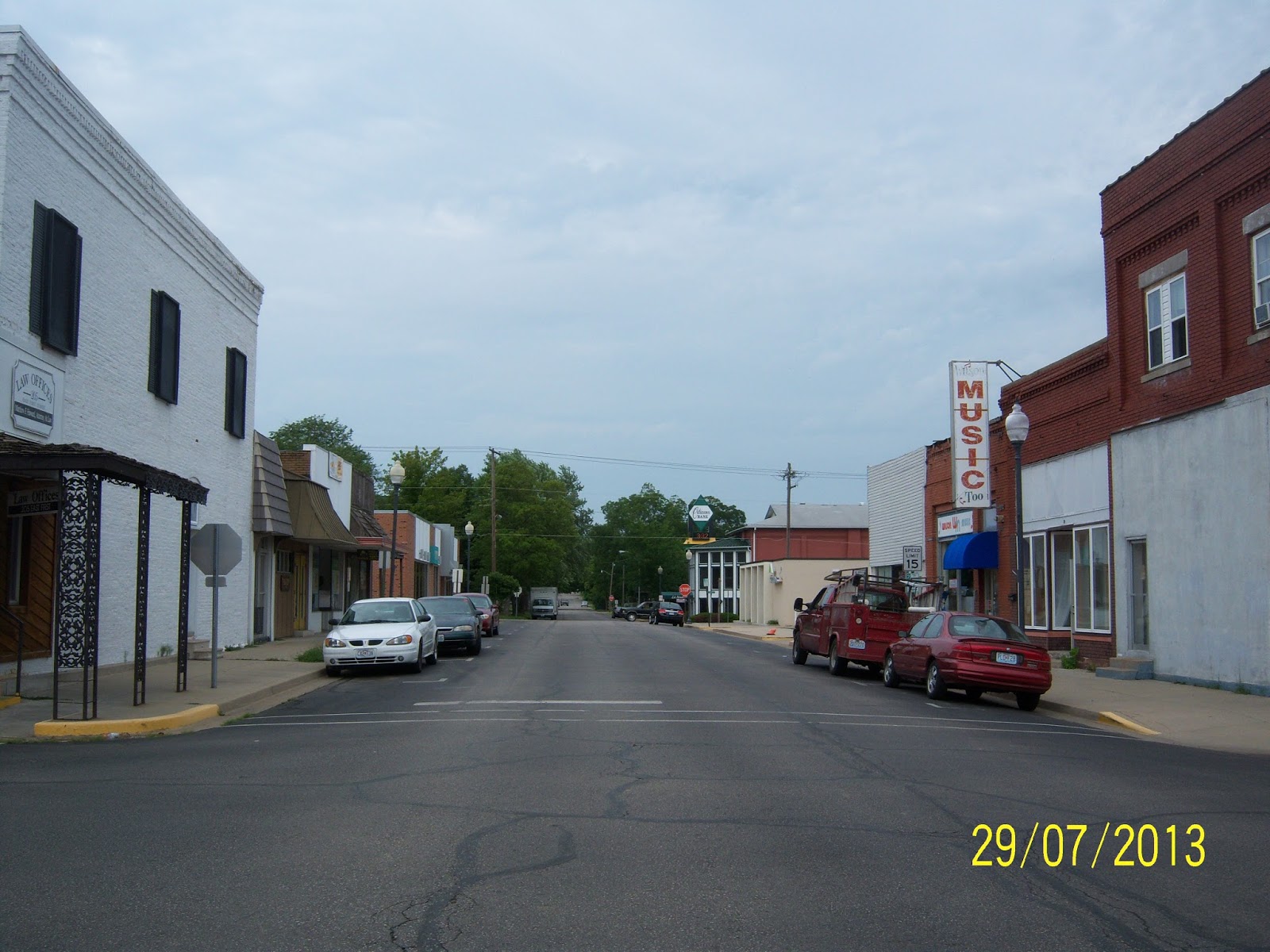
View of downtown Eldon, Missouri. This is where my grandmother grew up. In terrain, it is similar to Sneedville, Tennessee although not as green. The area is more rocky and I imagine that farming was a little more difficult. I have a better understanding of my grandma's background after visiting the area. I have no idea where she lived, (it wasn't in town) but there was a town to go to for supplies and not as cutoff as my grandfather in Tennessee.

This is the courthouse in Carthage, Missouri. In 1914, my grandparents came here to get their marriage license. I had seen pictures of this courthouse but pictures don't do it justice. It sits on a square surrounded by Victorian and Craftsman homes.

We had a great trip. We met new family (my husband's missing siblings), spent time with my family and got a better understanding of the history that made my grandmother who she was.

Sunday, March 31, 2013

The more I learn, the worser my family gets

I am trying to get my act together for the trip to Tennessee to track down the missing answers. I think I've read somewhere my gg grandfather was adopted so that's a dead-end although I plan to really check that out. When my mom did the trip in the 1980's, there wasn't as much documentation.

So I hit RootsWeb. I didn't realize that it was possible to search by name, by county. Imagine my surprise when I found these two tidbits. 


Martha Priscilla Rhea
BIOGRAPHY: She was a twin and her twin brother was named Aquilla and they were Herb Doctors. The common talk or story was that one of Priscilla's brother's did not like her husband and had killed him and put him in the river.Her brother helped her raise her twins James and John Jr.

John McCollom
BIOGRAPHY: His occupation was a music master. He died of unknown causes. He disappeared one day and never was found. He probably was taken by Indians who were raiding in the area at that time. As a young man he came and boarded at the Rhea Station, which was south of Sneedville, Tn. and across the Clinch river. It was the first home of the Rhea family. He met his wife Priscilla Rhea at this Station. 

I have a death date (not verified) for John McCollom. Now, it might be bogus and has to be added to the list of questions to answer. The note on RootsWeb does not identify the brother who didn't like John but it leads one to wonder if if might be John Elijah Rhea Jr. His son, John Carter Rhea, married Martha Jane Rhea, the daughter of the twin, James Northcross McCollom.

It took several days to unravel the relationship between Martha Jane Rhea and John Carter Rhea. They were second cousins. Now it gets even more sticky if indeed the brother disposed of Martha Priscilla Rhea's husband and not Indians as the other note suggests. However, the Indian story also holds some merit because Martha and John Elijah's mother was Indian.  

Monday, February 25, 2013

Accurate Research - Day 23 of the Family History Writing Challenge


In the midst of this writing challenge, I was sidetracked. In fact, this is catch-up. I was asked to update a tree on Ancestry.com for a family member. She doesn’t have the time right now to do the detail work. It’s fun and easy for me and my tree is pretty complete.

I pride myself on getting the facts right. I check names and dates. I check ethnicity. I double-check dates. I say that twice because I found that my great, great, great grandfather died 15 years before his son was born. What?

All right, I delete the death date I have and make a note to go back and see where I went wrong. I continue with her tree. Why are there three Martha Jane’s? There are three of a lot of the people. I can see why her tree needs help.

I flip back to my tree. I have three of some people too. Where did I go wrong? It seems that in my haste early on, some of the more distant relatives were double on the family trees I added. Back then, I wasn’t as careful.

It helps to pay attention. I no longer add references twice. I am very careful but after doing this challenge, I am so familiar with the family names that I know when they’re wrong. That doesn’t mean I get it right. The name “Rhea” is not that common but in Tennessee, it seems that all of the men are named “John Rhea.” Honestly, I get the handing down the name thing but in ten generations, there are eight!

So how did John Rhea’s father die 15 years before he was born? Obviously, I have the wrong John Rhea but with so many to choose from, which one do I pick. They are all born within 20 years of each other. That seems like an easy choice but there are variables.
For example, my great grandmother married her second cousin. That’s a chart I had to diagram to understand.

Martha Pricilla Rhea                and her brother               John Elijah Rhea Jr
1790- 1850                                                                  1804 – 1859

Married                                                                        Married

John McColloam                                                          Lucy Anderson
1773 – 1850                                                                1808 – 1865

(Already, there are new things to research. Martha and John McColloam died the same year. That’s a clue for something, another thing to add to the why list.)

They had:                                                                     They had:

James Northcross McColloam                          John Carter Rhea
1820 – 1898                                                                1842 – 1884   

So far so good, James and John are cousins. This is where it gets interesting. James is 24 years older that John.                           

Married                                                                        Married

Mary Polly Gray                                                           Martha Jane McColloam
1825 – 1888                                                                1848 – 1929   

They had:

Martha Jane McColloam

Martha Jane and John Carter were contemporaries. Regardless of the family relationship, they were both the same age. There were plenty of other choices for either of them but who knows what draws people together. That’s another thing to add to the I want to know list. You will also notice that there are three John’s. UGH! (As an aside, Martha and John had nine children. None of them are named John.)